in brief
- A customer brain is a shared body of customer knowledge used to answer business questions; its findings need evidence, dates, and clear limits.
- Interviews, reviews, and transaction records answer different questions. Buyer testimony is not purchase data or a representative measure of demand.
- RELVO starts with public market evidence. Company files and exports can enrich the same Market Brain; interviews address named evidence gaps.
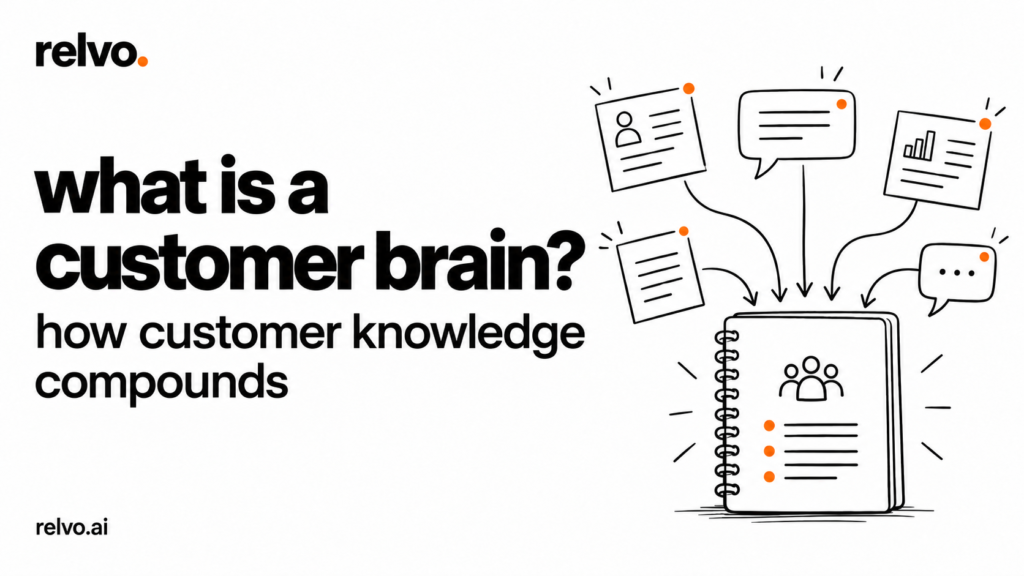
A customer brain is a shared, continually updated body of customer knowledge that a company can question and use in decisions. It connects evidence from research, customer conversations, product use, and market signals, while preserving where each finding came from.
The useful test is practical: when someone asks why customers are leaving, can the company answer from what it already knows? Can it show the evidence, separate the customer groups, and identify what still needs investigation?
RELVO’s Market Brain starts with public accounts of buying decisions: reviews, complaints, switching stories, and buyer discussions. You can begin with a URL before connecting company data. Adding interviews, support exports, or past research makes the same Brain more specific to your company; live CRM, support, and commerce integrations are not available today.
why do customer questions keep returning?
Consider a hypothetical software company trying to understand weak trial conversion. Sales calls mention price. Support tickets mention setup. Analytics shows people leaving before they complete an important task. An interview study says customers like the product.
Each source answers a different question. Price objections may come from buyers who finished the trial. Setup complaints may come from the people who never reached the useful part. Positive interviews may overrepresent engaged users.
A single summary that says “customers want better value” loses those differences. A useful customer brain keeps them available. The team can examine who said what, when it happened, and whether the evidence concerns evaluation, adoption, or renewal.
It also remembers the question was investigated before. When a new pricing discussion starts, the old evidence remains usable, with its dates and limits attached.
what belongs in a customer brain?
Start with evidence relevant to the decisions the business makes. Depending on the company, that may include:
- Customer interviews, surveys, and research reports, with sample details.
- Sales conversations and reasons for won or lost deals.
- Support conversations, complaints, and recurring workarounds.
- Product usage and transaction records, where available.
- Public reviews and market conversations about alternatives.
These sources carry different kinds of information. A transaction records a purchase. An interview records an account of a purchase. A review reveals what a reviewer chose to describe. Treating all three as equivalent would make the answer less reliable.
The system needs to preserve that distinction, along with dates, customer or segment context, and the link back to the original material. Otherwise, adding more data can simply make a weak conclusion harder to inspect.
what can a customer brain reveal, and what remains unknown?
The research example on RELVO’s homepage asks why buyers do not stick with protein bread and snacks in India. It reports that 81% of buyer opinions about the protein claim were negative, from 48 opinions, while 54% of taste opinions after trying were positive, from 26 opinions.
Those figures concern opinions in that study. They do not establish the percentage of all buyers who distrust protein claims, and they do not measure repurchase. The homepage explicitly identifies the material as buyers’ accounts of what they did and why, rather than purchase data or a representative survey.
This matters for the decision. The findings give a team a reason to investigate trust in the claim and the alternatives buyers use to judge value. They do not justify announcing that claim doubt causes churn.
The example leaves repurchase open and proposes interviews with recent buyers. A customer brain should be able to make that boundary visible: evidence available, interpretation offered, question still unanswered.
how does a customer brain differ from a crm or research repository?
A CRM usually organizes the commercial relationship: accounts, contacts, opportunities, and activity. A research repository stores studies and supporting material. Both can supply a customer brain.
The distinction is the job the team expects it to perform. A customer brain should help answer questions across those sources and carry useful findings forward into subsequent work. Storage and search are part of that job, but finding a document does not automatically resolve a customer question.
The name alone tells you little about the implementation. PeopleMetrics uses “Customer Brain” for a product centered on existing research, while other vendors use the term more broadly. Ask to see the sources, the answer, and the update process before comparing systems.
how should you evaluate a customer brain?
Choose a recurring decision, such as why a segment cancels or which objections block a sale. Use material the team knows well enough to check. Then examine the answer:
- Does each meaningful claim have supporting evidence?
- Are different segments and time periods kept separate?
- Does it distinguish customer testimony from observed behavior?
- Can it acknowledge conflicting findings or missing evidence?
- When new information arrives, can the team see what changed?
A fluent response is easy to admire. A response that helps the team decide what to do, and what to investigate next, is a better evaluation target.
how does ai-native research update customer knowledge?
A customer brain needs a way to refresh its understanding. AI-native market research describes workflows in which AI helps gather, organize, and analyze evidence. New research can answer a gap the existing knowledge exposed, then become part of the evidence for later questions.
Customer digital twins address a related but different problem: representing a customer or group, sometimes to explore possible responses. A model’s simulated answer still needs to be distinguished from something a real customer said or did.
For a team starting now, the first step is to choose one customer question and assemble the evidence already available. Tell RELVO which buying decision you need to understand. The conversation can start with how to investigate that question and which missing evidence would matter most.
3 Responses