in brief
- Brand switching research reconstructs the previous choice, dissatisfaction, buying trigger, alternative, and tradeoff.
- Cancellation surveys can identify stated exit reasons, but they rarely establish the whole sequence or verify what happened next.
- Compare switchers with people who stayed, keep competing explanations visible, and validate company-specific conclusions with company evidence.
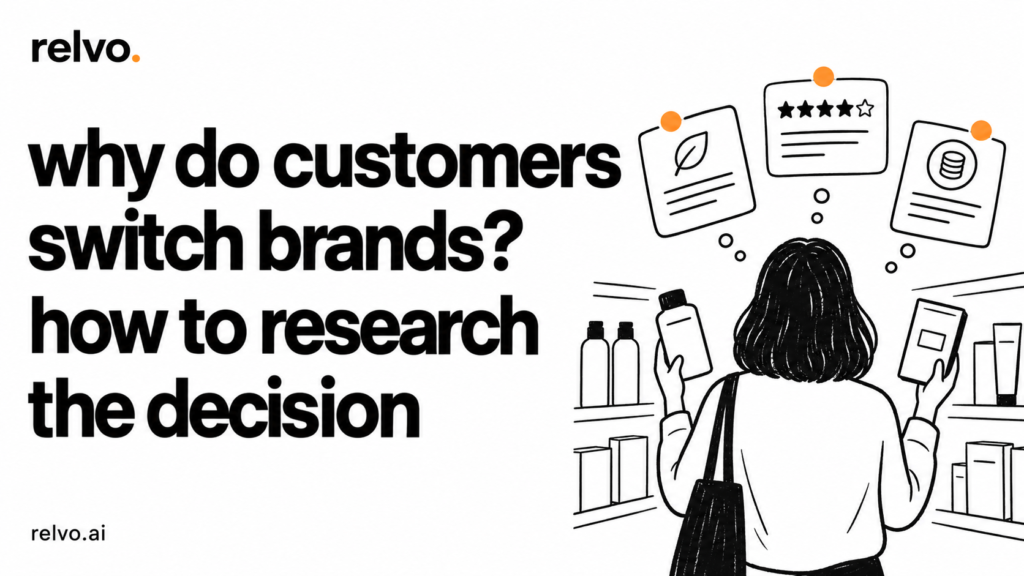
Customers switch brands when an alternative becomes preferable or the existing choice becomes impractical in a particular buying situation. The research task is to reconstruct that decision. A label such as “price” or “quality” is a starting point, not a complete explanation.
A customer can dislike a detergent for months and keep buying it. A stockout, a change in household needs, or a promotion may finally prompt a different purchase. Research that captures only dissatisfaction misses the event that made switching possible.
what does a cancellation survey miss?
A cancellation form is designed for a brief answer at the end of a relationship. It may force someone to choose one reason when several mattered. It can also miss the alternative selected, whether the customer had already switched, and whether the departure was temporary.
For an FMCG brand, there may be no cancellation moment at all. Someone simply buys a different shampoo. Loyalty research must therefore establish the purchasing sequence rather than borrow a subscription-company form.
A stated reason for leaving is evidence about the buyer’s account. It does not, by itself, establish the cause of every lost sale.
research note from relvo
what can new coke teach us about switching research?
Coca-Cola’s account of New Coke says the new formula was preferred in taste tests, while those tests missed attachment to the original. The original formula returned in 1985.
Our interpretation is about the research question: liking an alternative taste and accepting replacement of a familiar brand experience are separate judgments. This history does not establish why any present-day customer switches. It shows why a narrow evaluation can leave a consequential part of the decision unexamined.
how do you reconstruct a switching decision?
| part of the decision | question to ask | what to retain |
|---|---|---|
| Previous choice | What did you buy before this? | Specific product, situation, and period. |
| Dissatisfaction | What was becoming difficult or disappointing? | The problem, with a supporting account. |
| Trigger | What happened before the different purchase? | The event rather than a broad attitude. |
| Alternative | What else did you consider or try? | Other brands, workarounds, and doing nothing. |
| Tradeoff | What did you accept to make the change? | Higher cost, inconvenience, or lost benefits. |
Ask for the most recent decision. Let the buyer describe it before offering categories. Establish what happened first, what was considered, and what was actually chosen. If they cannot recall a detail, leave it unknown rather than supply a plausible answer.
how do you check whether a switching pattern is useful?
Compare accounts from switchers with buyers who faced the same problem and stayed. A common complaint may not explain the difference. Look for independent records, relevant purchase situations, and contradictions. Several posts describing the same incident should not count as several independent decisions.
worked example, not a customer finding
A hypothetical coffee buyer dislikes a rising price but continues buying the familiar brand. After a nearby shop stops stocking it, they try another brand and remain with it. The buyer’s account needs to retain the price concern, the missing stock, and the experience of the replacement, because each could matter to a different commercial decision. No part of this example is an observed relvo result.
Use the pattern to choose a next test: availability, positioning, product experience, or a follow-up study. Do not announce that a single factor causes churn across the customer base. See how to investigate buying triggers for the interview timeline.
If switching accounts are scattered across reviews and past studies, begin by naming the decision you need to make. Bring that question to relvo.