in brief
- Incomplete evidence can support a limited decision when the action is reversible and the downside is controlled.
- Match research effort to the decision’s cost, uncertainty, and consequences rather than demand certainty for every action.
- Record what is known, the missing evidence, the next test, and the condition that would change the decision.
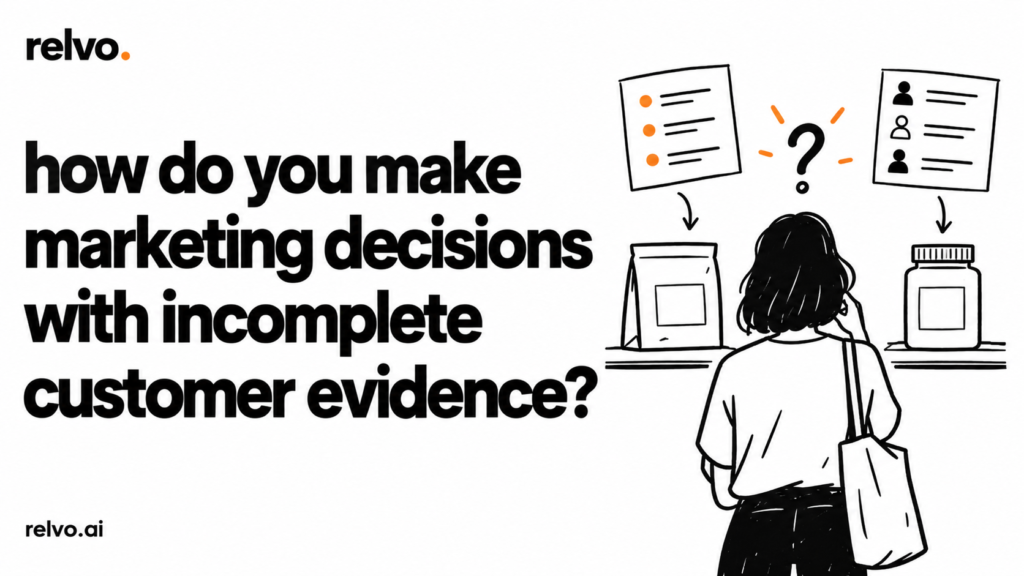
Make a marketing decision with incomplete customer evidence by matching the action to what is known and limiting the cost of being wrong. A reversible message test can proceed on a narrower base than a permanent packaging change or a large inventory commitment.
The goal is not to manufacture certainty. It is to choose an action whose scope the evidence can support, while keeping the unresolved question visible.
what should a decision brief contain?
| field | what to write |
|---|---|
| Decision | The specific action being considered. |
| Known evidence | Sources, dates, scope, and relevant buying accounts. |
| Interpretation | What those sources suggest, without upgrading it to a fact. |
| Missing evidence | The uncertainty that could change the choice. |
| Downside | Cost and consequences if the interpretation is wrong. |
| Next step | A bounded action or study and its revisit condition. |
A small test can be a reasonable decision while the broader claim remains unproven.
research note from relvo
what does an fmcg example look like?
hypothetical brand decision
A breakfast brand sees public accounts suggesting its benefit claim is confusing. It could examine two message drafts with relevant buyers before replacing every pack. That study would assess understanding and credibility. It would not, by itself, establish a sales uplift.
A packaging replacement introduces production, distribution, and shopper-recognition consequences. The same limited evidence that justifies a wording investigation may be insufficient for that larger commitment. State the difference in the brief.
how can lego ideas illustrate a staged decision?
LEGO Ideas says supported proposals may be considered for production. Interest and the decision to produce are distinct stages in the published process.
Our interpretation is that evidence can advance an idea without settling every later question. A signal can justify review while questions about delivery, economics, and the final offer remain. The example is not a rule about how other brands should count demand.
how do you choose the next research task?
Ask which uncertainty could reverse the proposed action. If the decision depends on whether a claim is understood, examine comprehension. If it depends on repeat purchase, seek relevant behavioral records or clearly scoped buyer accounts. Do not commission a broad interview study when one narrower question would do.
Keep the cost of delay in view as well. Waiting for evidence can be costly, but that does not make a weak conclusion true. A team can decide to proceed with a limited test and still describe the underlying explanation as uncertain.
what should stop or change the action?
- A relevant contrary case that undermines the proposed explanation.
- Evidence that the buying situation differs from the one assumed.
- A product or price change that makes earlier evidence stale.
- A result showing the test measures the wrong behavior.
- A downside larger than the agreed scope can tolerate.
These are examples of revisit conditions, not a universal operating checklist. Write the ones relevant to the decision before seeing results, so the team cannot silently move the goalposts afterward.
what does relvo do with an unanswered question?
An evidence gap is an output in relvo. When existing material cannot answer the question, the Brain records the gap and offers research that would close it. Public market evidence can start the work without company-system connections. Thin category coverage should lead to targeted research rather than an invented model.
See how to handle conflicting findings when the missing answer is a disagreement between sources.
Specify the decision and what would make you change it before asking for another report. Bring that question to relvo.