in brief
- Complaints identify problems to investigate; their frequency alone does not determine a product roadmap.
- Prioritize by the affected buying situation, consequences, workarounds, independent evidence, and the cost of a proposed change.
- Test whether the proposed fix addresses the problem before treating complaint volume as demand for a feature.
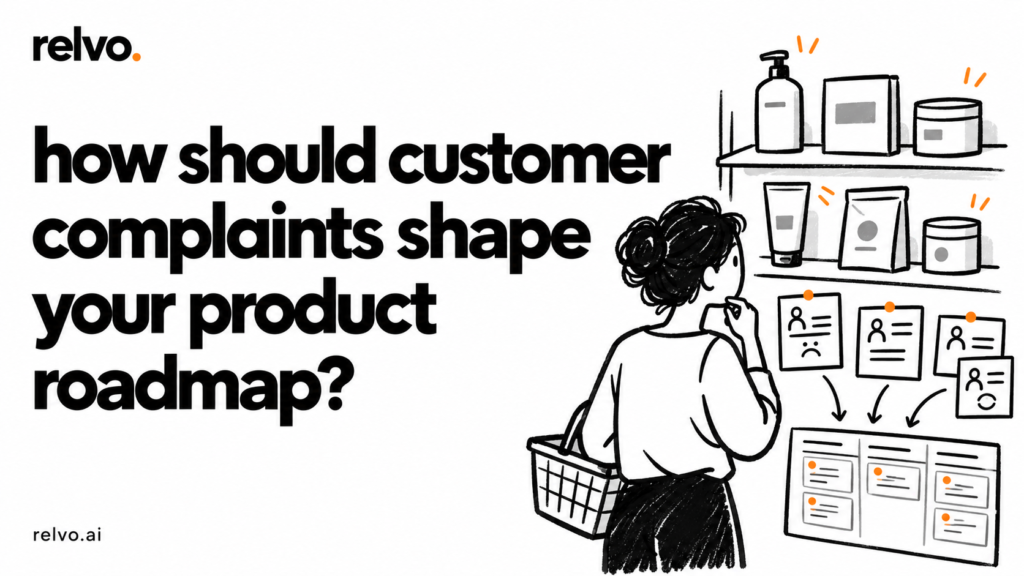
Customer complaints should shape a product roadmap by revealing problems, consequences, and unmet needs. They should not automatically become feature requests ranked by volume. A complaint repeated by many reviewers can be easy to notice, while a less visible problem prevents a relevant buyer group from using the product at all.
A snack brand might hear that packaging is hard to open. That observation leaves several questions unanswered. Does the difficulty prevent use, cause waste, or merely irritate? Which pack size is involved? Did the buyer abandon the product? Would a new opening mechanism introduce another problem?
how did domino’s connect feedback with a product change?
Domino’s December 2009 announcement described a change to its core pizza recipe and said customer feedback informed the work. The changes included crust, sauce, and cheese.
That is a documented product change, not proof that every complaint should trigger a redesign. Our reading is that feedback needs a route into the product itself. A request for “better taste” still requires product development and testing; an analyst cannot specify the correct recipe from complaint text alone.
what should you record before prioritizing a complaint?
| question | evidence to seek | why it matters |
|---|---|---|
| Who encountered it? | Buying situation, product version, channel. | Different groups can need different fixes. |
| What happened? | Specific incident and consequence. | Irritation and blocked use are different. |
| What did they do next? | Workaround, return, switch, or continued use. | The consequence can inform a test. |
| What contradicts it? | Positive accounts and unaffected users. | A universal fix may create new costs. |
| What remains unknown? | Missing experience or outcome. | The roadmap can include research first. |
A complaint describes a problem. A roadmap decision also needs an account of who is affected, what the consequence is, and whether the proposed change would help.
research note from relvo
Keep the buyer’s proposed solution separate from the underlying problem. “Make the pack bigger” might reflect a household needing several portions, poor availability, or frustration with the unit price. Those explanations call for different changes.
how can a team avoid prioritizing the loudest group?
Name the evidence base. A support queue contains people who contacted support. A public review collection contains people who published reviews. Neither is automatically a cross-section of the customer base. Group related records, check duplication, and preserve the date of the event.
Compare the group with the commercial decision. A product aimed at single-person households should not be redesigned solely around complaints from large households. Equally, an unfamiliar buyer group may reveal an opportunity worth investigating. The evidence supports the question; it does not settle the strategy.
a decision card to reuse
Record the problem, affected buying situation, consequence, supporting evidence, counter-evidence, proposed change, and cheapest useful test. Assign an owner and a revisit condition. Keep severity and recurrence separate rather than hide them in an unexplained score.
what should happen before a complaint becomes a feature?
Test the mechanism. For the hypothetical snack pack, compare opening and resealing in the intended use situation. Observe whether the new design fixes the difficulty, then check costs and other constraints. Interviews can explain the experience, but physical usability needs observation.
A finding can also end in “we need more evidence.” That is a legitimate roadmap outcome when the decision is expensive or difficult to reverse. Choosing the right research method helps distinguish an explanation gap from a measurement gap.
Use customer evidence to specify the next decision, rather than convert every complaint into a promised feature. Bring that question to relvo.